|
Inspired-Training COMPLICATIONS OF
Isobaric Counter Diffusion (ICD) seems
very fashionable on the net at the moment. With OC and CCR Divers getting deeper
for longer than ever before, accidents are happening. Old school experts need to
shrink back into the caves they spawned from...their often archaic advice is
worthless. With formal decompression ceilings getting
in the 100 metre range, traditional gas switching methods and funky dive
software could leave you less than chuffed! Counter Diffusing gas gradients occur every time you switch from a light to heavy gas e.g. gas switch from Trimix to Nitrox almost always without incident. Gas switches from Trimix to Nitrox or even Heavy Trimix to Lighter Trimix typically cause a jump in END (equivalent narcotic depth) also. People do these switches all the time without getting (noticeably) injured. However, when certain conditions arise e.g. the gas switch occurs at a decompression ceiling AND the jump in END is sufficiently large, then horrendous injuries can and have occurred. The author believes that dives in the 80metres for 30minute depth / bottom times range are sufficient to cause noticeable injuries from ICD, although Helium content and ascent rates can make injuries possible even shallower. The severity of the injuries will reflect the current tissue controlling the ascent ceiling for example: Deep gas switches (below 12metres) generally impact fast tissues, particularly the vestibular apparatus. IEDCS (Inner Ear Decompression Sickness) examples have been recorded numerous times at deep stop gas switches where the new mix contained insufficient Helium resulting in a jump in END. IEDCS is the most well known symptom with its debilitating extreme vertigo and vomiting. However, any jump in END at or near an ascent ceiling may cause DCS somewhere. Jumps in END can occur during 'Air Breaks' / 'Back Switches' and of course deco gas switches. If the END changes dramatically at or near a decompression ceiling...BEWARE. Shallow gas switches (shallower than 21 metres) can cause similar consequences to slower controlling tissues. Slow tissues are less sensitive to jump in END - they bubble - but you don't often notice it. Several divers have made panicked gas switches after a rapid ascent. Rapid ascents will bring decompression ceilings much deeper and even send them below the current predicted stop depth. Bubble Model decompressions used during Extreme dives (80metres for 30minutes etc) will cause ceilings to stay very close to diver. Contrary to their original postulates - ascent ceilings will not disappear how ever many deep stops you do! Experience has shown that doing lots of Deep stops will not speed up shallow decompressions either. Older Bubble Model software use will put divers in very vulnerable situations as depth and time increases. A quick and dirty approach for larger dives suggested by Steve Burton is END's should remain constant or be relaxed very slowly, with a maximum 5% drop in Helium for every 1% increase in nitrogen - of course this won't apply for common or garden trimix dives as this is well trodden territory but consider it when dropping below 80-100metres for extended bottom times. To know for sure what the biggest drop in Helium is permissible, simply run the dive-plan through
DecoChek
still the only real-time and complete deco plan
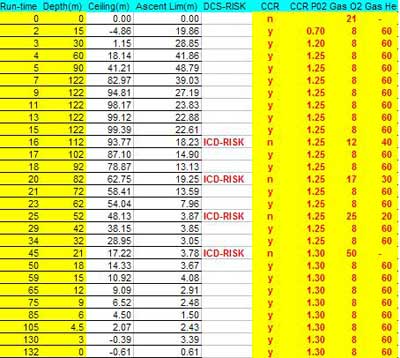
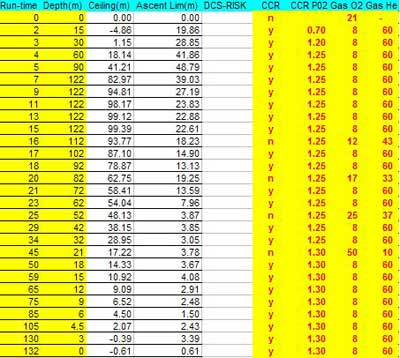
analysis program. Below are two screen grabs from an early incarnation of DecoChek highlighting ICD warnings. The dive profile is effectively 122 metres for 7 minutes. Image on left shows ICD warnings triggered by OC bail-out switches from CCR containing insufficient Helium and a subsequent jump in END at the ceiling. The image on the right has had Helium optimised in the breathing mixtures to minimise Narcotic Jumps. DecoChek comes in OC and/or CCR formats and will optimise the dive plan before you dive it. In the examples below you will see that the closer the stops come to the 'ceiling' the less END latitude is available. The subsequent release of Decochek automates the Helium recommendations offering advice as to minimum Helium levels in future gas switches.
The above examples highlight some minimal risks, if the gas switches were more severe or bottom time longer then serious injury could occur. An illuminating IEDCS paper is circulating on the NET by Doctors Doolette and Mitchell. The text suggests the physiological processes behind IEDCS and the impact of counter diffusing gases on IEDCS. The paper makes loose recommendations as to gas switching protocol. Divers embarking on aggressive technical dives should obtain a copy or get a large team of support divers to hold them while they vomit disorientated on the up-line. The
DecoChek
program from Daglish/Ellyatt/Burton makes Mark Ellyatt
|