|
The
DecoChek Dive analyser is a tool for mixed
gas divers wishing to check a dive profile before using it. There are
dozens of decompression planning applications on the market, most give a
different solution for ascending. Some planners give acceptable profiles
if YOU know how to use them, some give totally
inadequate decompression plans, do you know which
ones these are? Are You using them?
The DecoChek Spreadsheet incorporates the
CDM-18 algorithm. Developed by Stephen Burton and Mark Ellyatt, the
CDM-18 algorithm has been used on some very impressive dives, most
recently:
Grzegorz Dominik's
World Record Deepest Wreck Dive
220 metres
on the Yolanda in March 2006
Rob Lalumiere's
World Record Deepest Wreck Dive
193 metres
on the USS COOPER in May 2005
Dave Shaw's World Record Deepest CCR Dive of
270 metres
in the Boesmansgat
Cave system Oct 2004
Mark Ellyatt's World Record Deepest Scuba Dive of
313 metres
in the Andaman Sea in Dec 2003
As you can see,
the Officers don't use BUBBLE models, so why would the Troops?
Further deep dive validation's include:
170m for 21, 100m
for 25, , a 195m for 10, plus 140m for 12 on 20+ occasions. During dives to HMS
Victoria, 22 mutli level dives from 150/8 + 120/8 and 110/15 + 80/16 were
conducted. For shallower testing it has been used 90m+/15 on 67 man dives.
Shallower dives are too numerous to mention.
Analysing a dive plan takes 15minutes...Fixing the
dive plan within the
DECOCHEK
analyser takes as little as 10minutes...for moderate dives.
A large dive might take 2 hours to fix if the plan producing software was an
older bubble model.
Any time spent on profile analysis is well spent if you consider
the alternatives
Since its inception
6 years ago,
DECOCHEK is still the only decompression plan
analyser. DECOCHEK
compares your dive plan against the CDM-18
algorithm. Alternative algorithm's such as Bulhmann, DSAT,DCAP and USN are
also supplied with the program. Comparisons using these established matrixes is
very straight forward. The program will display decompression violations as
warnings. The warnings can be removed by increasing stop times or making
adjustments elsewhere in the dive plan. If you can use Microsoft Excel and have
some understanding of dive planning you can use DECOCHEK.
The
DECOCHEK analyser is the only program to advise
when Counter Diffusing Gas (ICD)
complications are present. As technical divers descend deeper and longer than ever
before, a true understanding of counter diffusing gases is paramount.
The dive analyser provides ascent advice that has WORKED in the past, there is
no guesswork. Its data source is based on actual man dives and data down as deep
as 313m by Mark Ellyatt recently. The half times and ascent limiters were developed over many years by
commercial companies and scientific / hyper baric experts. The DECOCHEK
analyser
will check dive algorithms used in any software available
or printed tables. Some are fine already...many
are not
Many theories
regarding safe decompression have come onto the technical scene, some promising radical decompression plans. Some
Bubble models are so
far removed from empirically tested algorithms, they defy belief in their
ability to safely decompress a human being. Unless a decompression algorithm can
demonstrate human testing, it should be treated with utmost scepticism.
(see UHMS testing protocols)
A couple of
revolutionary bubble models have been marketed heavily recently. One
owes its testing database purely to petri dishes of gel and technical diving
salmon and goats! The other was tested within the confines of a
supercomputer! Every dive YOU perform using these models
makes you part of the validation process. As this is often the case,
consider purchasing a personal recompression chamber for the times the fancy
math is not correct.
Bad dive plans are
similar to smoking cigarettes, the affects on the
body are totally cumulative, but the first ones generally don't hurt! Repeating bad dive plans again and again will cause
increased decompression sickness inevitability, due to a damaged or compromised circulation
system. Before you dive
again in to the unknown, spend some time analysing the decompression plan
looking for anomalies that could severely impact this dive, or a future one.
Long gone are the days of
manned test dives, instead customers and students are the preferred means of validation.
Its very easy to congratulate success, and even easier to ridicule failure. Many
decompression software titles are available, all promising a great deal...
They
cannot ALL be right, as their outputs differ
enormously.
The analyser is available in
40 or 100 data point versions-
CCR is fully supported
, so you can now check suitability of BAIL OUT mixtures at different depths
The
40 point
version gives sufficient waypoints for
analysing most
advanced mix gas dives to 150metres (depending on bottom
time and model used to generate original plan)
The
100 point
version has sufficient data points to plan
dives of an extreme nature or track repetitive dives.
DecoChek
40
costs £30
DecoChek
100
costs £50
*** DECOCHEK
will be sent by email on receipt of payment
***
Click here
for FREE fully functioning demonstrator
(needs Microsoft Excel)
Download article
Assessing dive profile safety V1.6.pdf
We have included
some examples of these decompression program analysis on this website. You will
see how each program predicts the ascent, and how they compare with each other
and with the empirically man tested algorithm embedded in the
DecoChek analyser.
To see the
software comparison pages click here
Some software
products give totally acceptable results but most
do not!. Be aware
that decompression software is the result of the programmers understanding of
the subject, and usually marketed by individuals with a scant interest in how
their products will be used beyond recreational exposures.
This is why decompression
plan analysis is so important, and easy with
DECOCHEK
See in real time
how decompression stops are generated via the appropriate half times. The
Cutting edge decompression matrix easily seek out the weaknesses embedded in popular
dive software and even published tables. Inputting your
dive plans and intended gas mixtures will advise you how ascent gases could influence
your safety with regard to Isobaric Counter Diffusion.
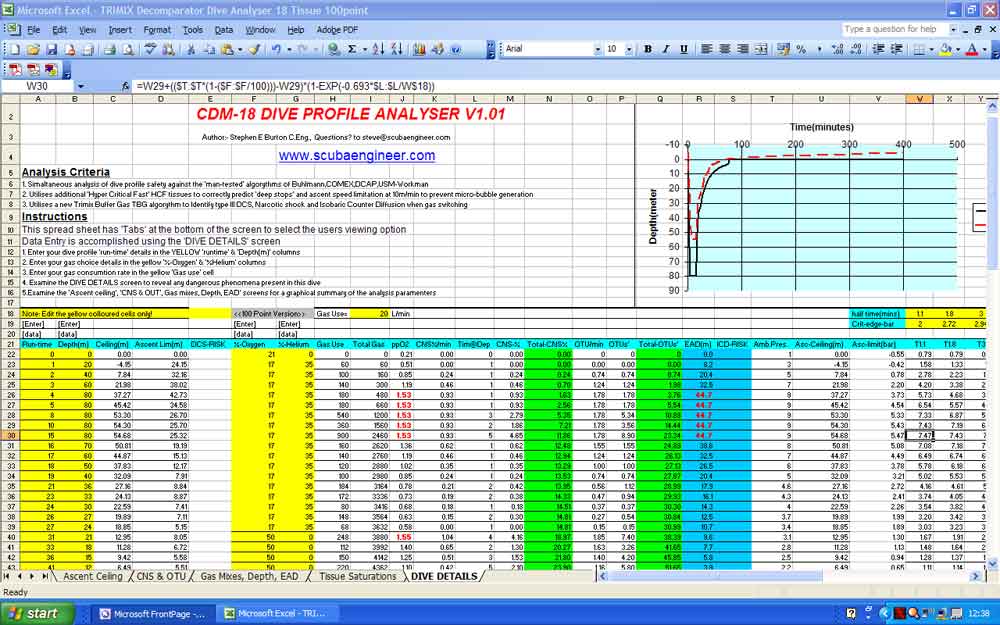
The
DecoChek
has 5 different screens, that translate the numbers into graphs, so you can
analyse your dive easily!
The analyser becomes invaluable as explorers
venture deeper and deeper.
DecoChek-
Popular Software Analysis
Back
DecoChek-Help
File
DECOCHEK
in use
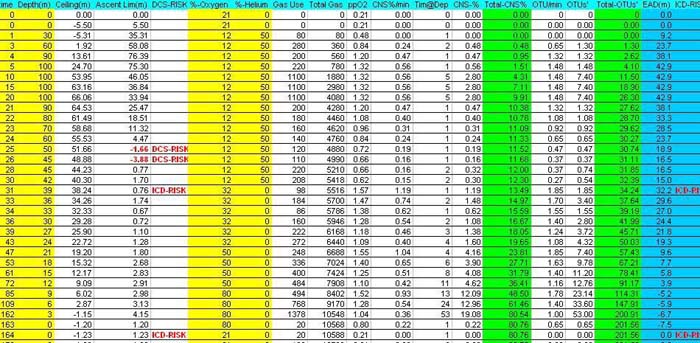
The dive plan in
screen shot one below, was
generated by a popular software program. The dive plan generated went on to give
significant decompression injuries both during the dive and post dive. The diver
in question could have easily prevented injury by adding further decompression
stops and/or breathing a more appropriate decompression gas. But how would could
he have known? Technical divers are guinea pigs for software
designers and training agencies! Some dive plans created by popular desk top planners can be
better described as suicide notes! With proven planning advice and some empirically
tested decompression parameters, we believe predictable advanced diving is
within all technical divers reach.
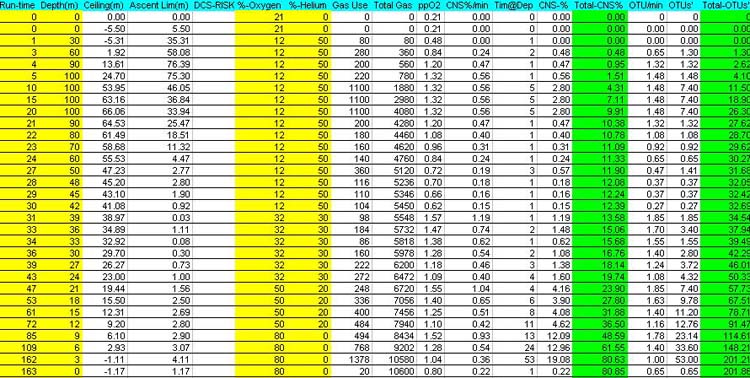
In the second screen shot, we see how the dive plan was simply fixed to become safer.
Deeper stop times were manipulated to remove the ascent ceiling
violations (DCS) (Although time deeper could also have been reduced).
Just as importantly
though, was the removal of the counter diffusion warnings (ICD) triggered at the
gas switch deco
stops. By adopting modern deco strategy and adding sufficient amounts of helium
to the decompression gas, complications can be minimised. DECOCHEK
will advise where helium should be added and how much
Screen shot 1 Faulty dive plan
(partial
screen shot)
Screen shot 2 Risks
understood and removed
Pre gas switch decompression stops extended and helium added to deco gasses
DecoChek
shows all Gas Planning, DCS, CNS, OTU information plus
Counter Diffusion
Gas Safety warnings
DecoChek
software has five
screens.
Below are examples of the additional data screens
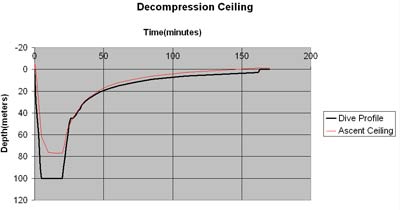
Screen shot from
DecoChek
showing previous software plan as it violated ascent ceiling.
The graph view allows easy evaluations of distance to decompression ceiling
and efficiency
of the overall plan.
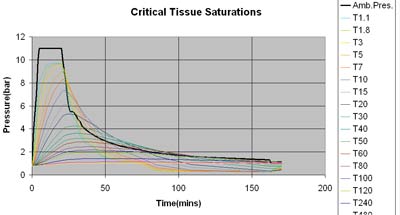
Screen shot from
DecoChek
showing tissue saturations over
dive time
After some short practice time,
anyone can have full control over their
dive plans, adding
safety... removing risk
Have
fun…dive safe…dive educated
HOME
copyright Mark Ellyatt
email@decochek.com
|